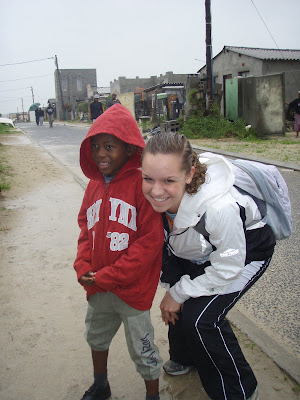
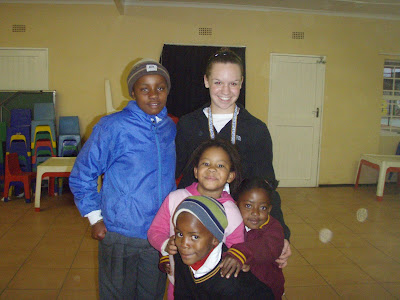
 This morning was nice. We were able to sleep in. Well that is if you consider 8:00a.m. sleeping in. The latest I’ve been able to sleep in this whole trip anyways. Then at our leisure we went to breakfast before loading the bus for another day filled of festivities. On the bus ride to the Apartheid Museum the tour guide reinforced the concept of ubuntu. Ubuntu is when one person of the same “kind” succeeds then the people of that “kind” also succeed. Same goes for losses. Therefore, everything that a person does affects their “kind”. Outside the Apartheid Museum stood concrete pillars representing what South Africa now stands for. Some of the pillars said democracy, responsibility, diversity, equality, and reconciliation. I thought this was good, how South Africa had been able to come to such strong roots after Apartheid. When entering the museum I entered through the white people’s entrance. From there I was able to look at white people’s pass cards. These cards were used when going anywhere in South Africa to make sure the people were in the right color boundaries. The black people’s pass cards were more torn and worn than the white people’s meaning that the black people were carded a lot more than white people. I then followed the white person’s path up a ramp. The black people’s path was a bunch of stairs, representing struggle and how much harder they had to work to get to the same destination in life. Next we went to see a quick video on how the conflict of the apartheid began and what had caused it. The apartheid began when the drought came and all the blacks from the country could no longer farm so they moved to the city. People did not want the black people in the city so they started to try segregating people. That didn’t work and the government got mad so they started to make laws that started the apartheid. During the apartheid the type of government system used was a parliament. More and more laws kept getting implemented and before the black people knew it, good jobs were incredibly hard to find. Some of the black people went to work in mines for white people, searching for gold. The conditions in which the black men stayed were horrendous. Basically all they had was a bed. Walking through the museum I was able to see the order of apartheid struggle. The fact that some white people opposed apartheid really surprised me. There was a woman by the name of Helen Suzman who was a member of parliament and was extremely against apartheid and stood up against it, but no one listened to her. In the museum there was an exhibit of pictures that Peter Magubani took during the time of struggle for the black. One of the quotes he used to describe the black people was, “They drift through the streets in small packs, like rubbish in the breeze.” I felt that this really explained nicely how people were treated only because of the color of their skin. The museum also had a part about Nelson Mandela. The section described his life and his commitment to succeed. When walking out of the section we were able to pick up these sticks, and each color represented a characteristic about Nelson Mandela. We then placed the sticks all together in stands to show what Nelson Mandela was all about and had created for South Africa. I chose a blue one which stood for respect because that is what Nelson Mandela fought for. We went through the museum extremely fast and I really wish we had more time to spend there. The museum really helped me to understand exactly what went on during the apartheid. By learning the past I can help prevent this from happening in the future. Lunch today was a on the go type of thing. We had sandwiches. Mine was cheese and tomato, but the cheese they use here is always shredded. On our way to the house Nelson Mandela had during the apartheid we stopped at the local mall in Soweto. Soweto is a suburb of Johannesburg. At the mall we made a quick stoop at the post office to get some international postage. On the postage was a picture of Nelson Mandela which just showed me how respected he is in South Africa. The picture was celebrating Nelson Mandela’s 90th birthday. Many of my fellow travelers got off the bus to go to the local McDonalds. The teachers came back on the bus with all of their food then wouldn’t let us go and get any. They ended up surprising us and bought us all cheeseburgers and French fries. This just showed me even more how amazing traveling with Discovery Student Adventures is. The house that Nelson Mandela lived in before the apartheid had about 3 rooms. On the walls outside of the house there were still bullet holes from when the police shot his house during the struggle. Outside of his house stood a tree which was called the Freedom Tree. The tree is where he planted the umbilical cords of all of his children and his grandchildren. They were planted within the first 10 days of the child’s birth. Inside of the house were artifacts from before and after the apartheid. There were also a lot of things from his wife, Winnie, and her struggle while he was in jail. The first time she saw him in jail was 2 months after the arrest and then not again until a whole year later. The Mandela house wasn’t really what I expected it would be like, but I guess that just shows how much of a “normal” person Nelson Mandela was. The orphaned and vulnerable children we visited was one of those experiences that changes the way you look at the world forever. Let me step back a bit and tell you about the center. The children that were at this center were from the ages of 3-18. These children were somehow affected by HIV/AIDS. Either their parents had it or had died from it, or they themselves had HIV/AIDS. Children went to the center during the day for daycare and food if they were 3-6 years of age. The children that were older went to the center for breakfast and then came back after school to do homework and have a snack, before leaving the center at 5p.m. each night. At the center the children were taught basic life skills such as cleaning, gardening, and health awareness on HIV/AIDS. The place was called Elton John Masibambisane Centre and had about 200 children each day. Touring the place, made me wonder how they ever had enough room for 200 children as the space was limited. I started to interact with the children right away. First I went to talk to some boys that were working on their math homework. The children were ecstatic to see us, but trying to concentrate so I went onto a reading group. There I read the story of Aladdin to some boys. During the story they commented about specs on a boy that had come. At first I had no idea what they were talking about but then I found out that it was glasses. Sometimes it was hard to understand the children due to their thick accents and some of them didn’t even speak English. The children tried to read some and I was surprised at how low their reading level was for their age. The children were about 10 and could barely read a sentence. That proved to me how lucky I am to have a good education. As I started taking pictures with the children they asked if they could take some of their own on my camera. I let them and they started acting silly but were having a lot of fun. They no longer wanted to read. Then I was approached by a girl that wanted to take some more pictures with me. I allowed and after we were done I began talking to the girl. Her name was Fezeka meaning dreams come true, and she told me that someday all of her dreams would come true. I told her that with a good education anything was possible. Fezeka was 15 years old. One of the questions she asked me hit me hard. She asked if I had parents. Immediately, after she asked that question I was on the verge of tears, because I knew that she didn’t. I went on to tell her that I did. She explained to me that her mother had died when she was 3 years old, along with her dad. Fezeka lives with her aunt and brothers a couple blocks from the center. Each night she walks the other children home first and then goes home to her family. Fezeka asked me about America and if it was nice. I told her that America was nice and full of a promising future. She asked me if I liked South Africa and such and I explained to her that it was an amazing experience. The fact that Fezeka still was so happy even though she had so little made me realize how fortunate I am to have everything I do. We then circled up as a group and began playing African games. I found it great how the children of all ages were able to play peacefully and happily together. A little girl came by me and began holding my hand, she obviously felt left out and I included her right away. Her cute little smile spread to others. We got in groups singing and dancing and playing along. A smile beamed from my face this whole time. The room was vibrating with a rhythm of young people who had promising opportunities ahead of them due to this center, even if they did have HIV/AIDS. When leaving Fezeka told me that someday she was going to come to America and find me. I told her that I would most definitely welcome her into my world as she did for me into hers. The experience at Elton John Masibambisane Centre is extremely hard to convey to other people. The children literally have changed my life and the perspective I see in my future and the future of the world. For dinner we went to a local buffet and had some African cuisine, similar to what we have experienced in other days of the trip. As today comes to a close, I reflect and cherish what I have learned so far, but can not wait to embark to Kruger Park were more memories and thought provoking facts are waiting.
 The adventures of today began with a continental breakfast at the hotel. Half of us were in our discovery t-shirts for picture opportunities. Due to the length in which we wore our shirts during travel, I had to wash mine in the sink at the hotel. The Johannesburg weather was brisk with a chilly breeze spreading through the air. The wintery weather was evident because all the trees were bare, having nothing but branches. This is because of the lack of rain these trees receive. Most people associate cold weather with bare trees, but this is not the case. In Cape Town the trees were full of leaves due to the rain there.
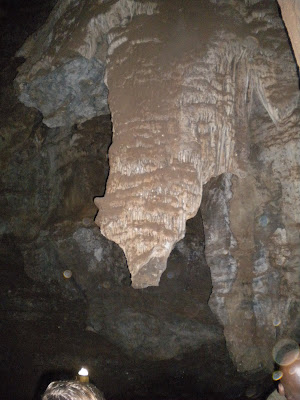
From the hotel we went to see the Sterkfontein Cave. There we also went into a museum that explained how caves are formed. This is when acidic rain decomposes the rock it lands on creating a gaping hole and over time that hole gets bigger. The Sterkfontein Cave is the sight where "Little Foot" and Mrs. Ples were found, showing human adaptation and evolution. Mrs. Ples was found first at this site. Many scientists now believe that she is actually a he and should be named Mr. Ples, based on the curvature of the jaw. This cave was used for mining limestone and therefore parts of the mine were blasted out. After this happened a piece of tibia was found. In 1992, a scientist then went into the cave and looked for 2 days until he came across a piece of bone that seemed to fit with the tibia piece. He knew where to look because most of these fossils were found in rock called breccia. Breccia is made of sediment soil. From there most of the body was found and thought to be an ancestor of humans. We were able to see the spot in which "Little Foot" was found and how it had gotten in there and died. We saw the opening where "Little Foot" must have fallen through from outside. The hole was hidden by all the shrubbery. Walking through the Sterkfontein Cave made me realize how close I was to my ancestors. The cave was big and at its lowest point 60 meters from the surface. Inside the cave we were able to see stag mites and stag tights. The walls of the cave were beautiful covered in spider like cracks. At one part of the tour the guide turned the lights out and the cave got pitch black. I couldn’t even see me hand that was touching my nose. Some parts of the cave were hard to maneuver through. Along the way we also saw a bat in a small hole in the ceiling rock. Rocks hung from all over the place and I was terrified that the whole cave would fall on me. I thought it was a miracle how two skeletons that link to ancestry past could be found in a gentlemen’s backyard. This World Heritage center is one that is essential to preserve.
Driving out of Sterkfontein Cave we drove through a reserve of animals. There we spotted lots of rhino and antelope in their natural habitat. As we approached, the antelope sprung from where they were grazing and ran. Eventually we parked and hiked across a field of grasses, some of which looked like ones found in the United States, to go to an archeological sight. Upon arrival we got some African cake, bread slices, and fruit. While eating the food we listened to a presentation by Collin Mentor, an anthro-paleontologist that worked on dating fossils from millions of year ago. Dr. Mentor explained the processes he used in his studying and some information about the evolution of humans. He explained how the DNA in humans is 99% the same as in chimpanzees, and gorillas are only 98%. During the presentation Dr. Mentor showed us some of the artifacts that he had dug up. One of the artifacts he showed us was in the same family as humans and had a rather large jaw and teeth that were wide and flattened. He explained how that jaw belonged to something that ate grass, due to the size of the jaw and structure of the teeth. This surprised me because I didn’t really know how scientists came up with these statements. Another statement that amazed me about Dr. Mentor was when he took out a tooth that he had put in a bag. He held up the tooth, looked at it for about 5 seconds and said, "This is the tooth of a female baboon." I was shocked, to say the least, and immediately my hand went up wanting to know how he knew this. He explained that baboons have rather long teeth especially past the root. He explained that he knew it was a female because of the total length of the tooth. Male baboons have longer teeth for fighting reasons than females do. From the presentation we went to see where he dug. In the rocks around the digging sight we could see fossilized tusks of elephants and baboon skulls. The area in which he dug was extremely rich in fossils. The coordinates of the earth were also marked out so when he dug something up he recorded what he found and exactly where he found it. Dr. Mentor said that he was probably going to dig in that sight for 15-20 more years. Wow, that guy must have a lot of patience. Just when we were about to start digging the rain began to pour, ending our opportunity way to fast. Even if we didn’t get to dig, the experience was awesome due to the amount of information I learned.
Since our experience at the archeological sight was shortened we had more time on our hands than normally predicted. With that time we took a quick trip to the local Camilleon Village. The experience there is one that will never be forgotten. As soon as I stepped off the bus I was swarmed with people saying, "Sister, why don’t you come see what I made?" or "What is your name? Where are you from?" They would shake my hand and while doing so they would pull me into their little shop. Eventually I just had to say, "I don’t want to look!" Then I would just walk away. The venders were so crazy that I felt the need to stay in a big group. When I found something I liked I put my bargaining skills to the test and sometimes I would get myself far, others I would end up 5 rands cheaper, not worth it. The venders would all say they had hand crafted their item and make up unbelievable stories about what has happened to them just to make you want to buy the items they sold. When I was waiting on the bus there was even a man who came on for one of the other people that had bought from someone else and asked him if he wanted to buy something. To say the least the venders were desperate but I guess that was their way of life and a man has to do what a man has to do. If I am having a bad day in the future, I will go to the village market and then I will feel wanted and popular.
From the cultural village experience we went to an even more cultural place of African tribe simulations, the cradle of mankind. There we visited tribes of Zulu, Bashoto, Xhosa, and Pedi. At one of the tribes we had the chance to taste grubs. Something I never plan to eat again. It wasn’t that they tasted all that bad it was just the fact that I was eating insects that had me grossed out. In another one of the tribes I tried to communicate with the children there. They obviously didn’t speak English. When the child went to the parent to talk the parent said, "Shhhh!" and put their finger on their lips. So when I went to try to communicate with the child again the child repeated what their parent had done. A classic child move. Once finished visiting the tribes we went to a ceremonial dance. The dance was fun and everyone was able to get involved. The whole ceremony was in different languages, so I had no idea what was going on. After the ceremony was over we had African dinner. For the first time, I had the chance to try crocodile meat and ostrich soup, neither of which were all that bad. The rest of the meal was also good, especially the vegetables. Gathered around the table the group bonded laughing quite a bit, most likely because how tired we were.
Tonight we worked on games to play with the orphans we are spending time with tomorrow. I know that all the effort and fun in learning the game will pay off tomorrow when I experience even more life changing events and people.
 The last morning in Cape Town had surprisingly the nicest weather. The sun was shining, and rain was not evident. This situation made for the perfect sight seeing trip. So after breakfast we all loaded the bus, suitcases and all, to head out to Cape of Good Hope and Cape Point. Once again we were left driving through the countryside. Along the way we ran across a rather rare type of antelope. We also passed by an ostrich farm. That is when our guide told us how to tell female and male ostriches apart. Telling them apart is by the color of their legs. Males have pinker legs the females. It amazed me how close the biggest birds on earth were to the bus. They were about 6 feet away and posing perfectly for the camera. Roaming around in the streets were baboons. Our guide told us to be careful with our belongings because if we set our backpacks aside a baboon would most likely take it and run up the hill with it. Baboons need food. A bag of chips a day is what they need in order to survive. It is much easier for them to steal from tourists rather than search for it on their own. The baboons can not tell whether food is present in bags so they steal the whole thing to have a better chance of receiving the food.
When arriving at Cape of Good Hope the mystical area came to life as the waves roared against the rocks and the mountains glowed in the sunlight. Right outside of the bus two ostriches waited patiently to get their picture taken. Cameras began to flash because we all wanted to take in the unbelievable sights in the 10 minutes we had there. Cape of Good Hope is the most south-western point of South Africa. This point was somewhere that a lot of sailors got lost and they wanted name the cape something else but were not allowed therefore the place received a more promising name. After taking in all the beauty we loaded back onto the bus to travel to Cape Point.
At Cape Point we hiked up a bunch of stairs as our legs burned just to see the view that was found at the top by a lighthouse built in the later 1800's. The hard climb was well worth the view at the end as we were able to see where the currents of the Atlantic and Indian Ocean meet. At the top there was also a sign saying how far we were from other cities in the world. Too bad Cedar Rapids, Iowa wasn't on there. I wonder why. But the sign did say that there were only 12,541 kilometers to New York. After finishing the photos and taking in all the fresh salty sea water air we raced down the mountain to have some time in one of the shops there. In the shop there was a lot of neat African handmade jewelry.
From Cape Point we went to see where some of the animals that live along the coast were. To do this we went to Boulder's Beach in Simonstown, South Africa. Here we were able to see the African Penguin in its natural habitat. The African Penguin lives along the coast of South Africa and is listed in the Red Data Book as a vulnerable species. The beautiful fur of the penguin glimmered in the sunlight. I was surprised at how much fur the penguins had on them. I would have thought due to the hot conditions of South Africa they would have had less fur. The fur does keep them waterproof while they're swimming so maybe that is just the amount that they need. As the cute penguins walked around I tried with all my might to prevent myself from petting them. The penguins seemed friendly, like a pet I would have at home, but looks can be deceiving. African Penguins bite, along with all other types of penguins. The penguins in a warm environment was quite unique and something I would have never expected to see. I am in South Africa, so anything is possible. Outside of the National Park were little street markets. There I put my bargaining skills to the test to see what bargains I could find. We were short on time so there were only a few things I was able to come away with. Also in the streets a performing group put on quite the musical show. Singing songs from their homeland. The music filled the street with a rhythmic beat and helped me to come to reality that I am in South Africa.
My stomach growled as I got back on the bus. Next stop, Harries Pancakes. When I heard of where we were going I thought, oh good American food. Once again I was wrong. Yes, there were pancakes, but the pancake was wrapped around African food. Mine was filled with Thai chicken and mushrooms. I gave the new cuisine a try, but my taste buds rejected the experimenting. I took a couple more bites and decided this food just wasn't for me. Instead of sitting there and waiting, a couple of other people and I decided to go shopping at the center in which the restaurant was held. Unfortunately, we ended up missing the dessert, which supposedly was delicious, a pancake covered in cinnamon and sugar. That's a bummer. The mall seemed to not have much in it that was a "true" symbol of Africa. There was a World Cup store, but since I'm not a big fan of soccer I decided to pass on buying anything. The World Cup is a huge deal in South Africa since in 2010 they plan to hold the event. All of the South Africans are excited and everywhere you go there is a count down until the day when it begins. I believe today in the airport I saw the count was down to 368 days. When arriving back at the restaurant there were street performers out. These men were doing eye compelling tricks with fire. Breathing and licking the flame, attempting some pretty dangerous stuff. This is another example of the true African culture.
From the restaurant we went to SANCCOB. A rehabilitation place for birds that find their home near the ocean go when injured or sick. There we met a penguin by the name of Rocky. Rocky was involved in an oil spill and was washed ashore. There they found him and cleaned him. Due to Rocky not being an African penguin they could not release him into the wild. So Rocky finds his home at the SANCCOB center and is a spoiled but nice penguin. Rocky is one of the few penguins there that do not bite. I was fortunate to have the chance to hold Rocky and his skin was extremely smooth. At the center we learned about a major oil spill of 2000 and how over 30,000 penguins had to be washed and 1,000 of those died. The washing process is complicated and very time consuming. When the penguins first come in they are evaluated. In the case of an oil spill the penguin's digestive system is rinsed out with charcoal and water. This is to take any oil out of the penguin that may be in there. Next the penguin is gently washed with soap and a tooth brush. The cleaner has to be extremely careful because at this point the penguin's life rests in the cleaner's hands. From there the penguin is disinfected and rinsed. This whole process takes one or more hours. Everything in the center is washed carefully to prevent the spread of disease. Fish is hand fed to the penguins. To do this the feeder has to wear particular clothing to prevent from getting bitten. Many precautions are taken at the SANCCOB center for the penguin's well-being, such as mosquito nets and mosquito repellent is hand applied to all the penguins. Penguins in the wild usually get malaria and it doesn't harm them, but when a sick penguin gets malaria the penguin will most likely die. There we also met a penguin by the name of Caroline, who had become almost blind. She permanently lives at the center and like Rocky she does not bite. Most of the people that work at the center are volunteers. The penguins at the center made me start to consider other fields of marine biology that I have not thought of before.
Our time in Cape Town was up and the Table Top Mountain experience was lost, but all the other amazing sights in the city had made up for the lost one. As we said our goodbyes to Tabby, our tour guide for Cape Town, and I realized what an amazing experience this was and how I will probably never come back to Cape Town, South Africa in my life. I took in one last breath of the coastal breeze as we departed for a city with more adventures waiting, Johannesburg. 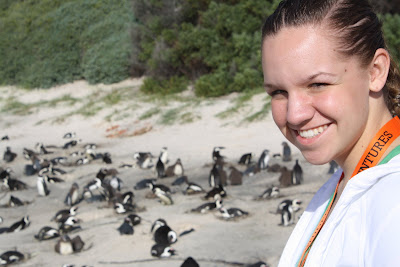
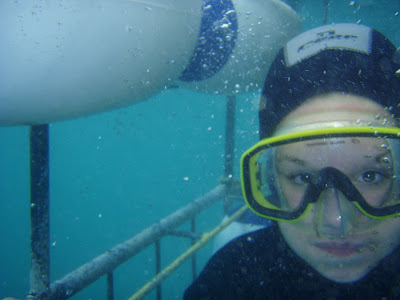 I woke up to the dark engulfing our hotel as we got on the bus for a trip of a lifetime. Although it was only 6:30a.m. the sun had not yet risen and the world of South Africa was asleep. That is exactly where I thought I should have been therefore, I decided to take a nice and long nap on the way to the cage diving company, a two and a half hour bus ride out into the country beyond Cape Town.
When waking I found an extraordinary view surround me. The mountains with glistening water snaking its way down. On the other side the Atlantic and Indian Oceans roared like a beast. The sun was just coming up over the mountains, casting a glorious beam of light on the world. To say the least the view was magnificent and incomparable.
Upon arrival at the cage diving company we were presented with an American like breakfast of cereal and breads. During breakfast the instructor told us to take some motion sickness medicine. This should have been my first clue that the ocean was quite rough. Of course I followed the directions and did as I was told. Once finished we went to a presentation from a marine biologist that studied the Great White Sharks. During the presentation I found myself thinking about my future and how someday that will be me up there talking to students about animals of the water in which I love. The presentation was really interesting, though. The marine biologist, Allison, talked about the misperceptions people have about Great White Sharks all because of the movie "Jaws". She also explained to us how good the senses of these creatures were. A Great White Shark can smell a drop of blood in an Olympic size swimming pool. Sharks do not mean to kill people. Usually when people are eaten by sharks the shark made a small mistake. We were all just hoping there would be no mistakes today. Along with some characteristics of the Great White we learned about its history and how it is thought that the Great White had been on earth for 40 billion years. This means the Great Whites were around when the dinosaurs roamed the earth. The evidence found to support this theory is found in ancient Great White teeth that have been dated back that far. The bones of Great Whites cannot be dated back because they are made of cartilage. No one was brave enough to ask the scariest question of all, has anyone ever died on this coast doing what we are doing today?
After the presentation we all boarded the boat for Shark Alley. Shark Alley is nestled between Seal Island and Dyer Island. About 7 kilometers off the coast. This is a prime location for Great Whites to live due to the water temperature and the amount of food that is found there. The ride out to the island was rough, like a roller coaster ride, but the seasickness did not set in until we stopped and waves rocked the boat back and forth with quite a force. At first the cage diving company started to bait the sharks. To do this they used a fake looking penguin and the head of a tuna. Sure enough the sharks began to come; one by one they would pop their ferocious heads through the surface and try to snatch the bait before it was pulled from under their jaws.
The first divers entered the cage screaming in fear. Rain began to pour and the waves picked up rapidly. The instructors called for the next group and any that were starting to feel sick. I immediately went down and the bottom deck was worse. My food began to churn and before I knew it I was getting sick over the side of the boat. The company helped me get into my wet suit because there was no way to stop me. I was too excited and didn't want to give up this once in a lifetime experience. I sat waiting for a while and I just kept feeling worse, but this was my dream and there was no way I was going to miss it.
Finally my turn came and I entered the cage with six other people. The last to go in was I and the freezing cold water had me shaking, teeth chattering and all. We hung on the top bars of the cage, waiting to be instructed to go under. My arms felt week, waiting with such fear and hesitation. There was no turning back now. Eventually after waiting for what seemed like forever the man screamed, "Go under and look to the left." We all took in great big breaths and submerged ourselves under the freezing water. Right before my very own eyes, inches from my face stood the deadliest creature known to man. I was not fased one bit, instead I was the most excited I have ever been. I have never seen such a dangerous and magnificently beautiful creature. Shattering the surface when we came back up for air everyone complained about the saltwater taste. For me, salt water had never tasted better. We continued to repeat the process becoming more amazed with each dive under and trying to catch the perfect picture to frame on that one blank bedroom wall. Once our turn was up we climbed out of the cage onto the rocking deck above. So amazed and excited our faces beamed with glowing smiles. Some experiences in life can never be forgotten, and this is one of them.
Sitting back on board just made me sicker and then the boat finally started and we departed back to shore. One the way we stopped at Seal Island, also known as Great White Shark's dinner plate. The island was covered with seals. I never knew so many of them existed, or could be found so close together. I litterally couldn't even see the surface of the island. After observing for a while the boat started moving and before I knew it we were back on land. As soon as I stepped on to the nonmoving surface I felt so much better. Although the experience made me sick my dreams have not changed for being a marine biologist. I guess I will just have to deal and learn to not get motion sickness on rough seas. Upon arrival on shore there was food waiting for us and I was starving. Cage diving was probably one of the coolest experiences and will never be forgotten.
The drive back to Cape Town was long, because we decided to take the more scenic route, riding right along the ocean. Many of us slept tired from the day’s excitement. At one point the bus stopped for us to see the Southern Right Whale. The glorious animal and its young were visible in a spot that it was not usually visible during this time of year. After observing the landscape of Cape Town, we headed to a local families house for a home cooked authentic meal and a drumming lesson.
The drumming lesson was very unique. We learned a basic pattern of different beats and sounds. From that we just kept on adding making the music bounce in my ears and vibrate off the walls of the house. The instructors then added different instruments like bells and such. Next came the dancers and before we knew it we were like our own little performing group, with a sound of everyone's heartbeat. The dinner was quite good. The dinner was made up of buboiti a type of ground beef with different spices added in. The butternut squash soup left a taste in my mouth craving more. The highlight of the dinner was by far the dessert. The dessert was a hot cake square covered in vanilla custard. Just typing this makes me want more. The dinner was a good way to experience African cuisine in its normal state. Although today was rough for me, the sights I have seen was worth any pain it may have caused. Tomorrow is a new day and I can't wait to see what it brings. 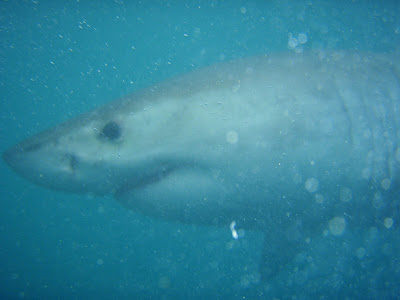
The morning wakeup call in South Africa must be the obnoxious sound of birds squawking through the window and the buzzer of the alarm in your ear. Let me tell you, it was quite unpleasant, but it did get me out of bed and into a nice warm, refreshing shower. Once dressed warmly for the day, I went down to breakfast to find that the South African breakfast is quite like an American one. Scrambled eggs were there along with a wide variety of fruit and some sausage and bacon that looked a little different then it did the United States but tasted much the same. From there we went to a lecture hall in the building next door which is now a school and used to be a prison. How fitting. Sometimes school may just feel like a prison. But this buildings walls were quite thick, a least 2 feet in some places. The lecture was probably one of the best I have ever been to, quite informing and interesting. And allow me to clarify something from my last blog. The word Coloured here simply means of mixed origins, such as Asian or Indian. In South Africa the word is not used as an insult. The word native here is an insult though and it would not be considered one while in the United States. During the lecture I also learned a lot about the history of the Apartheid. I found interest in the fact that South Africa has only been a democratic nation for the past 14 years. This means that while I have been alive, their freedom struggle was occurring. Also, most of the people that I have talked to here so far have been part of that struggle. I thought the information about how South Africa is the most diverse in their ecological system and is home to the fastest (cheetah), the largest (elephant), the smallest (shrew), the tallest (giraffe), and the most spider, snake, and scorpion species than anywhere else in the world. After the lecture we were able to visit one of the Black townships called, Langa, meaning the sun. Here I was quite surprised and shocked at what I saw. As we listened to the tour guide speak about the township in which she lived as she walked us through it I found it amazing that with all the resources we have people can live with so little. After the Apartheid, the government went into townships such as this one and started to rebuild. The government then ran out of money and were left to tell the people we will finish when the funds come available. Many of the people have lost hope. Rebuilding the townships present another issue, though. Once the housing is rebuilt the cost of living there goes up. Some people cannot afford these higher costs and therefore have to find somewhere else to live. In each house of the township about 3-4 families live. Inside the house there is a shared dining area among the families and a room for each of the families to live in. The families come together to take care of electrical and other costs. To say to least the township houses are quite small. Outside of the housing units I saw clothes hanging on the lines and trash spewed all over the ground, because people didn’t have the resources to sweep up trash after it spilled over when putting it into the garbage cans. In this particular township at least 35% of the people were unemployed. As the guide explained they were not sitting around and doing nothing, they were out looking for jobs and places they could make money to help support their families. While there the children of houses came out to greet us. Our guide explained that they were saying, "Here come the White people." This was an excitement for them and they posed for all the pictures we took. There was also a small shop in that township where many of us bought homemade jewelry and other handcrafted items. While leaving the township our in country associate told us something that really made me think. He said, "This is not about a way of life, this is about survival." We next stopped at another township that had a story of a woman that was quite inspirational. This townships name was Khayalitsha. In this township there was a lady by the name of Rosie. In order to understand the story of Rosie I need to explain the living conditions of Rosie. Rosie lived in a small shack. About 1/3 the size of a school bus. That is where she cooked, slept, and lived. This shack did not have air conditioning or heating, it barely had a door. All of the places where people live in Cape Town are quite close together especially in the townships. One night in a shack next to Rosie’s a candle was tipped over and the neighbors shack caught on fire. This fire spread like dominos and soon more than 300 shacks in the township were gone. Rosie escaped safely, but then went back inside the blazing shack to grab her to children. While doing this Rosie received some quite serious burns on her neck and arms. The burns were still visible when we saw her today, 20 years after the fire happened. The true inspiration I found in this lady was more than overcoming not having anywhere to live. It was the mere story of a lady who has a dream that someday no child will go to bed with an empty stomach in Cape Town. Each and every day Rosie gets up at 4:00a.m. to start the meals she cooks for the children. She cooks all day long feeding the children breakfast, lunch, and dinner. At first a local Catholic Church was helping her pay for all of the supplies, but now the church can no longer afford to help and she is left to pay for it all by herself. She receives day old bread from the bakery each day for free, 25 trays to be exact. At each meal she feeds anywhere from 200-350 children in her tiny little kitchen and shack. The children love Rosie and standing there watching everything this amazing lady uses to cook, pots and a small fire lit stove, the scene made me fall in love with this amazing lady too. Hopefully someday Rosie’s dream will come true. After visiting these townships I feel thankful and way over privileged for what I have in my life. I realized that it is small people with big hearts, like Rosie, that make the world a better place to live in. Though what I have experienced in the townships is quite hard to describe, I know that today’s experience will affect the person I become in the future. For lunch we went to a local church that cooked us up a traditional African meal. There was a beef stew, cabbage, butternut squash, and some delicious pudding. The people at the church explained how important the church was to the township in which it sat. At the church people from all colors and kinds came to rejoice. No tension rested there as everyone was accepted. Throughout my journey through the townships I was quite impressed with everything I saw regarding how accepting people were to White people. This proved that the Apartheid truly was over. I was also surprised at how close high income housing was to the townships, practically across the street. South Africa is becoming a nation of one. Today’s weather though was still bad. Due to the cold front that was moving in on the coast the guides decided to not risk going out to Robben Island because they weren’t quite sure we would be able to get back. Instead we did a backup plan for incase the weather is still bad tomorrow and we can’t go on the cage dive. We got a scuba diving lesson in a pool of the South African coast. The pool was outside and with a temperature of less than 60 degrees I can be the first one to tell you that the water was anything but warm. The water was about 55 degrees and even in a wetsuit I was freezing. Scuba diving was amazing, though, even if it was in a pool. The ability to breath underwater gives me indefinite possibilities. With the lessons we received today, our plan is if the weather is still bad we will go to the local aquarium on Sunday and scuba dive in their exhibits. After our dives the nice helper of the instructor gave us all hot chocolate to warm up on our bus ride back to the hotel. There we washed up and got ready for dinner at a great local restaurant. At dinner I ate a Prego Role. By far one of the best foods I have eaten since being in South Africa. A Prego Role is merely a steak coated in a tangy barbeque sauce on a bun. The chips "also known as fries" that went with it were also quite delicious. At dinner Robben Island came to us, as the principal of the school on Robben Island came to speak. It was interesting to find that only 22 children attend the school there and these are grades first through seventh. For these children there are 3 teachers. The children at these schools learn the basics and due to the budget cuts no longer get any of the arts. Although learning the basics does include learning all of South African’s 7 languages. And I thought it was hard learning 2. As my day in Cape Town came to an end and the rain continues to pour on the roof, I guess all I can do is cross my fingers for some good weather tomorrow to participate in the cage dive, a once in a lifetime opportunity to see nature at its best and at only one amazing and culturally astounding spot in the world, Cape Town, South Africa.
After leaving the Frankfurt airport all of us were immediately asleep on the airplane. Awaking only for dinner and breakfast we all were refreshed in the morning and ready for another fun filled day of travel. Once we arrived at the Johannesburg airport we exchanged our American currency for the African rands. From there another 4 hour layover began and we walked around the airport trying to get our first glimpse of the African culture. I bought a chocolate shake from the local fast food restaurant,Wimpy, and the shake was quite different than the normal American ones I am used to. It was sweeter and less choclately. The layover went fast and before I knew it I was taking-off from Johannesburg on my way to Cape Town. The flight to Cape Town went by quickly. I was able to get in a quick nap and was fed plenty of food. I'm pretty sure that during that 2 hour flight I had more food on a plane than I've ever had in my life. Landing in the plane brought us back to reality as it was raining on the group below. Not really what we were planning on seeing in Africa, but it was their winter so this type of weather was expected. After retrieving our luggage we hopped on our bus and while driving to the hotel we received a 25 minute tour of Cape Town. Based on the looks of everything I saw, I can still see the Apartheid present in South Africa. The view was obvious that Black people still lived in the poorest of housing, Colored people in the next best, and White people in the best of housing units in South Africa. The guide explained how when it rains, as it was today, the shacks in which the Black people live in have a lot of standing water in them. On our tour we also saw the hospital where the first heart transplant took place. Not being able to go to the top of the Table Top here was a bummer but hopefully as the weather gets better we will be able to make up that missed excitement. Once we got to our hotel we were able to take a shower...finally! The shower felt nice and refreshing before our cultural African dinner. Today, was a really nice and relaxing day, but tomorrow will be even more fun as we get to explore the city of our destination!
 Everything has happned so fast - in the blink of an eye. Yesterday started with a plane ride from Cedar Rapids, Iowa to Chicago, Illinois. The flight lasted about 35 minutes and then the 3 hour lay over began. After sitting around and trying to figure out how to play Skip-bo for a while we ran out of time due to our inability to read directions and then boreded the plane. My first encounter with Germans began there. The gentlemen that sat next to me was from Germany and spoke only a few words of English but even at that we had a nice conversation. The dinners served at 11 were quite interesting, some sort of pasta or chicken. A movie or two later I began my attempt to fall asleep. The heat in the plane and the amount of leg room ended that attempt and I gave up after 4 hours. The breakfast was served and the plane landed. Exiting in the 2nd asile had me lost on the bus. Not knowing where everyone was was scarry but after a couple messages on my blkackberry I found my way. We then walked through customs where we got our passports stamped! Frankfurt here we come! After meeting up with our travel advisor we were sent into the heart of Frankfurt to meet up with the rest of the group. From there we went into a skyscraper to get a birds eye view of the city. And Frankfurt is beautiful! As the breeze blew through my hair it hit me...I was in Germany! After a while of looking at the city from above we went to see some cultural aspects of the city and a cathedral built in the 13th century. From there we headed back to the airport and had some delicous German pizza. A whole German pizza just to myself was what I needed. From there we talked, got to know each other better, and started our blogs. After passing back through customs it leads me to where I am now. Waiting for the plane to arrive to take me to South Africa, our final destination and where the real adventures and discovery begins. ---
Powered by NetMobile.
______________________________________________________________________
This email has been scanned by the MessageLabs Email Security System.
For more information please visit http://www.messagelabs.com/email
______________________________________________________________________
|
Essential Programs Details
| Duration |
12 days |
| When |
June 2nd -
13th, 2009 |
| Focus |
Wildlife Research/Conservation
Political History
Culture |
|
 This morning was nice. We were able to sleep in. Well that is if you consider 8:00a.m. sleeping in. The latest I’ve been able to sleep in this whole trip anyways. Then at our leisure we went to breakfast before loading the bus for another day filled of festivities. On the bus ride to the Apartheid Museum the tour guide reinforced the concept of ubuntu. Ubuntu is when one person of the same “kind” succeeds then the people of that “kind” also succeed. Same goes for losses. Therefore, everything that a person does affects their “kind”.